FAQ chatbot
An FAQ chatbot answers the questions customers ask most, from answers you have written. The older kind matched keywords against a fixed list, and failed whenever a customer used different words. Deacon matches on meaning, reads the rest of your content as well, and starts from the questions your visitors have asked. Each one it couldn’t answer is kept for you. You are the human in the loop. You write the answer once, Deacon checks that it now gives it, and later visitors who ask are answered.
On every plan, including the free one.
At a glance
| What it is | A chatbot that answers common questions from answers you wrote, so customers don’t have to scroll a page of questions to find theirs. |
|---|---|
| FAQ page or FAQ chatbot | On a page, customers have to find their question in your wording. A chatbot takes it however they word it, and Deacon can read your FAQ page as one of its sources. |
| Where the questions come from | Your visitors. A question Deacon couldn’t answer is tagged Unanswered, or Wants a person when the visitor asked for one, and either way it counts towards the gaps left to answer. |
| How you add an answer | Press Answer this on the question, write a reply, and press Save & check. You can also add a question and answer on the Knowledge page without waiting for anyone to ask. |
| How you know it worked | Deacon puts the question to itself afresh and shows you what it would now say. |
| How far one answer goes | Deacon tries your answer on open questions like it and reports how many more it settled. |
| Plans | All of them. Writing an answer and checking it never uses up a plan’s answers. |
One question, from unanswered to answered
“Does Acme work with Okta for login?”
Tuesday, 09:14
A question your content doesn’t cover
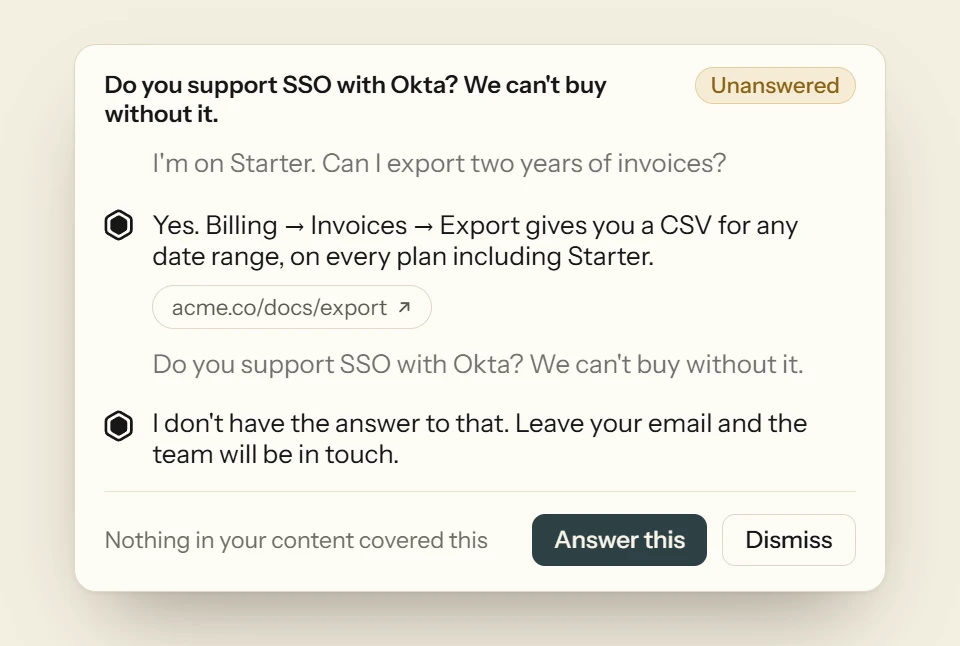
Sam asks whether Acme supports single sign-on with Okta. Acme’s docs never mention Okta, so Deacon tells Sam it doesn’t know and shows a box where Sam can leave an email address. In the dashboard the conversation is tagged Unanswered, and the count of gaps left to answer at the top of the Conversations page goes up by one. Had Sam asked for a person, it would read Wants a person and still count as a gap. When two or more people ask the same thing, it also shows as a topic, with how many of its questions weren’t covered.
Tuesday, 09:30
You write the answer once
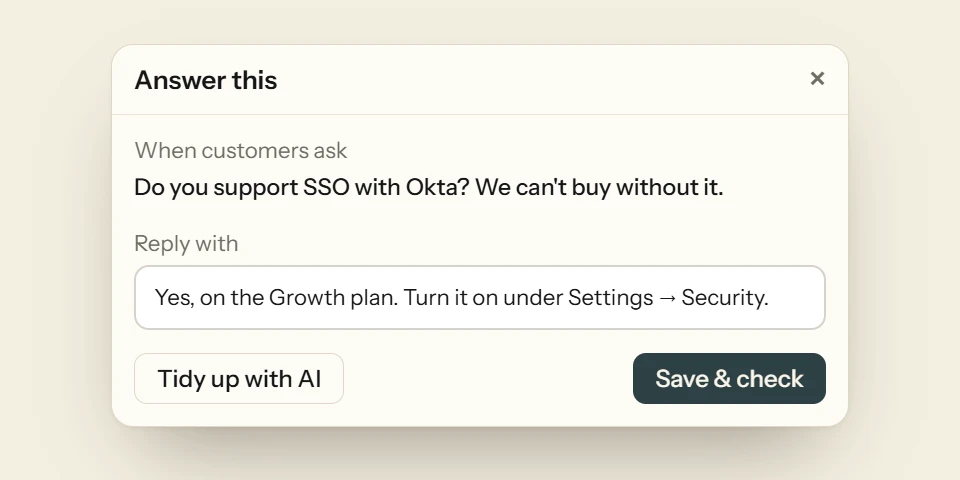
Open the conversation and press Answer this on the question. The dialog has two fields. When customers ask is filled in with Sam’s words, and you can reword it. Reply with is where you write the answer in your own words, up to 4,000 characters. If you would sooner jot a rough note, Tidy up with AI turns the note into a finished reply and adds nothing you didn’t write. A question that isn’t worth an answer can be dismissed.
Tuesday, 09:31
Save & check shows you the proof
Press Save & check. Deacon saves your answer as a source, which needs no retraining, then asks the question afresh, as a visitor would, and shows you what comes back. That check is never counted against your plan. The result is one of four. Deacon now answers the question, another source already covered it, Deacon still isn’t using your answer and you should make it more specific, or the check timed out and can be run again. It then looks at similar open questions and tells you how many your answer also closed. Here it was three.

Wednesday, 10:05
The next visitor gets your answer
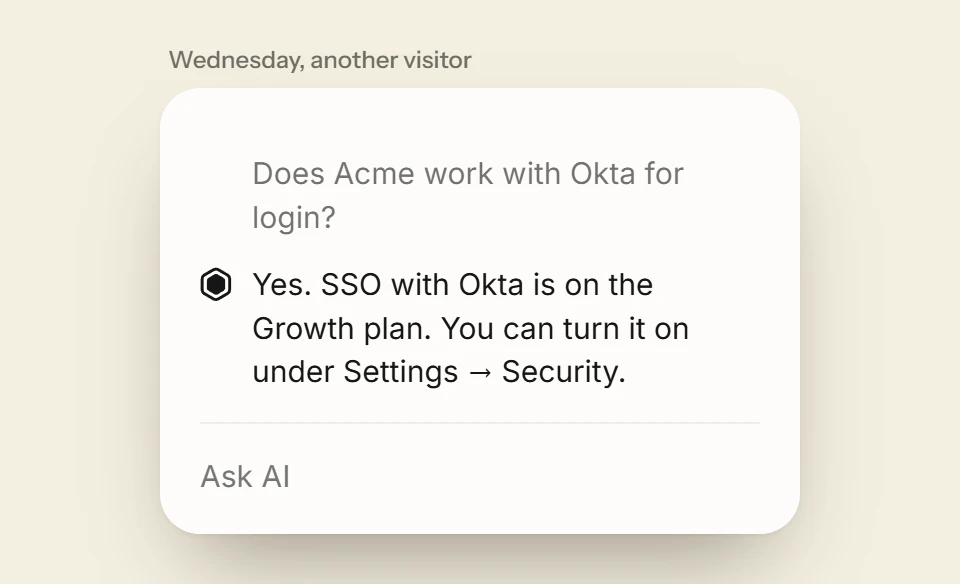
Another visitor asks whether Acme works with Okta for login. The words are different and the meaning is the same, so Deacon finds your answer and replies from it, in the visitor’s language. Nobody is emailed. An answer you wrote is preferred over your other content when the two disagree, which makes it the quickest way to correct something Deacon gets wrong. If you delete the answer later, the questions it closed are open again.
Write your first answer on the free plan
Install Deacon, ask it something your docs leave out, and answer it from the dashboard. The check that follows is never counted as an answer. You get 50 answers a month on the free plan, and it needs no card.
How to write an FAQ answer a chatbot can use
These hold for any bot that answers from what you wrote, and most of them hold for an FAQ page too.
Start from questions people asked
An FAQ written in a meeting answers what the team thinks customers ask. Use the questions from your inbox, your chat logs and your sales calls, in the customer’s own words.
One question to an answer
“How do refunds and cancellations work?” is two questions. Split them, so that each can be found alone.
Answer in the first sentence
Say yes, no or the number first, then give the detail. A bot and a hurried reader both get more from an answer that opens with the point.
Name the plan, the limit and the path
“Yes, on the Growth plan. Turn it on under Settings, then Security.” answers the next two questions as well.
Write it the way you would say it
An answer in a chat is read as a message from you. Leave out internal names and ticket numbers.
Date the ones that will change
Prices, limits and anything marked beta will change. Keep a list of those answers and check them when you ship.
Delete an answer when the docs catch up
A written answer covers something your documentation left out. When the docs cover it, delete the written answer, so there is one version to keep up to date.
Questions about FAQ chatbots
No, you can start with none. Deacon answers from your website and files, and keeps what it couldn’t answer. Those are the questions to write answers for.
The older ones were. They matched keywords to a script, and a question in different words fell through. Deacon uses a language model over your content, so there is no script or flow to build. Deacon vs ChatBot
Yes. If it is a page on your site, add it as a link. You can also paste it in as text, or add each question and answer as a Q&A, with up to ten ways of asking the same thing.
No. It writes each reply afresh from your answer, in the language the visitor used, so the wording changes and the facts stay yours. Save & check shows you one such reply before any visitor sees it.
Save & check tells you so. The usual causes are an answer too general to match the question, or another source that contradicts it. Make the answer more specific, or fix the other source, and check again.
Yes, on any site where you can add a script tag. Adding an AI chatbot to WordPress
Write your first answer
It takes about five minutes to install. The free plan is 50 answers a month, for as long as you like.