Website visitor tracking
Website visitor tracking means counting the people who come to your site, where they came from, which pages they read and whether they did what you hoped. Two kinds of tool share the name. One kind counts. The other kind matches a visitor’s IP address to an employer and sells you that as a sales lead. Deacon is the first kind. The script that runs its chat widget also counts your visitors, so one install gives you both.
On every plan, including the free one.
At a glance
| What it counts | Visitors, page views, visits, pages per visit, time on site and the share who left after one page. Under those are the pages people read, the sites that sent them, their countries and their devices. |
|---|---|
| What it never does | It never identifies companies or people. Every figure here is a total, and no visitor has a profile or a timeline. |
| Goals and funnels | Tag the actions that matter, such as a sign-up, with a line of code, an attribute or a class. A funnel is two to five steps in order, built from your goals, and it can start from Visited. |
| Cookies | Counting a page view doesn’t set a cookie. The script does set one, deacon_visitor_id, when it loads, so that a chat can follow a visitor from page to page. |
| Install | One script tag, the same one that runs the chat widget. A single-page app is counted each time its address changes. |
| Date ranges | The last 7, 30 or 90 days, each against the period before, or all time, whose change is the last 30 days against the 30 before. |
| Plans | All of them, the free plan included, and none limits page views. |
| What it isn’t | A full analytics suite. There are no filters, custom date ranges, exports or revenue figures. |
What you see once the script is on your site
All of it is on one page of the dashboard, under Analytics and then Website.
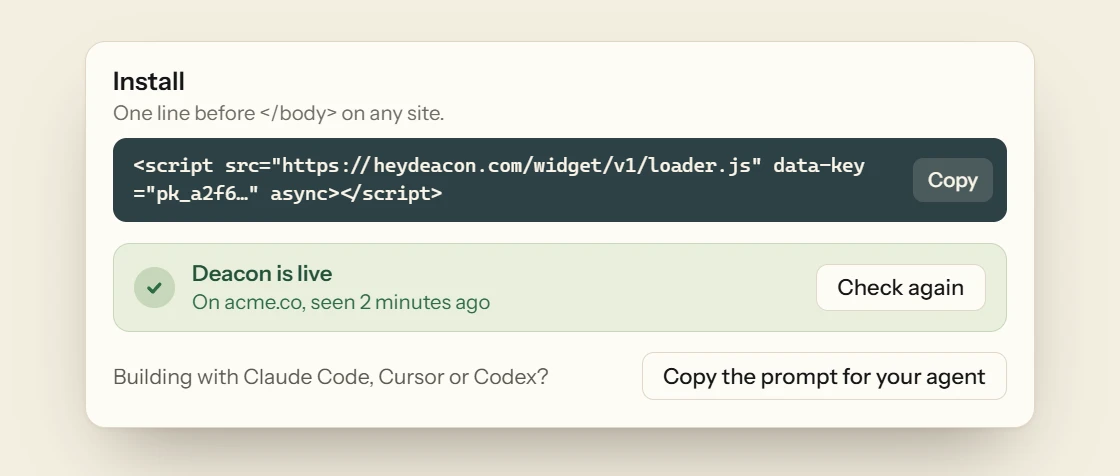
Paste one script and page views start counting
Put the Deacon script before the closing body tag, and add your domain to the list of sites it may run on. It is the same tag that runs the chat widget, so there is no second script. A page view is counted when a page loads, and again when a single-page app changes its address. Crawlers, headless browsers and development addresses such as localhost are left out. The Install page tells you when Deacon has been seen on your live domain.
See who came and what they read
Six figures run across the top. They are visitors, page views, visits, pages per visit, the share who left after one page and time on site, each with its change on the period before. A chart draws visitors, page views or visits by day, week or month, with the period before as a dashed line. Under it are ranked lists of your pages and entry pages, the sites and tagged links that sent people, their countries, and their devices, browsers and systems. A visitor is counted per day, so someone who comes back tomorrow is counted again.

Name your goals and build a funnel
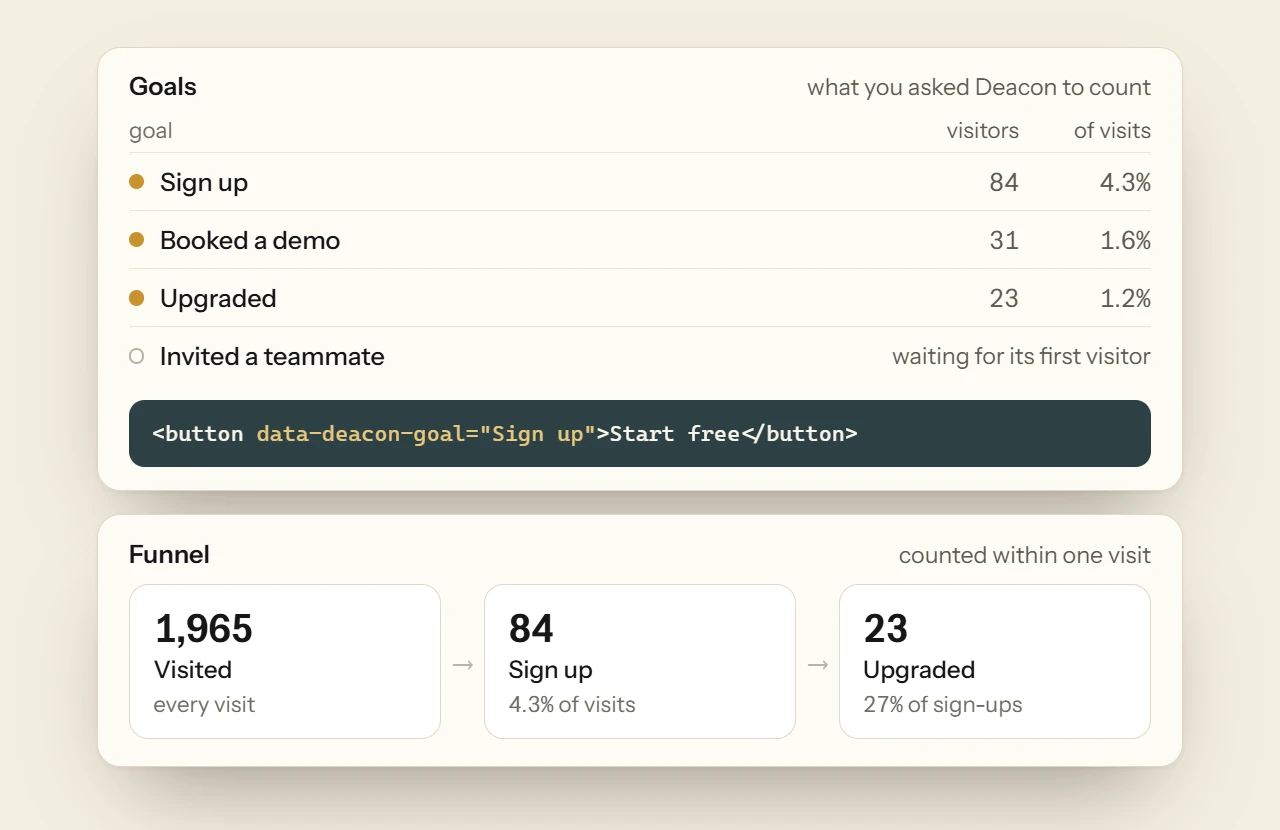
A goal is anything you want a visitor to do, such as signing up or booking a demo. Send one from your code with Deacon.track('Sign up'), or add data-deacon-goal="Sign up" to a button, a link or a form. There is a class as well, for site builders that only let you set a class name. A goal shows in the dashboard the first time it arrives, with how many visitors reached it. Put your goals in order and you have a funnel, two to five steps, which counts the visitors who made each step within one visit. The first step can be Visited, which is any page on your site. Goals are tagged in your code, and none can be defined by a page address.
Read what stands out
Worth knowing is a short list at the top of the page, written from your own numbers. It can tell you that one source converts better than the rest of your traffic, that a device converts worse, that traffic spiked, that a funnel’s rate moved, or that a new JavaScript error has appeared. The Sources table rates every source against your main goal. That is Sign up if you have a goal by that name, then the end of your first funnel, then whichever goal arrived first.

Visitor tracking is on every plan, with no page-view limit
Add the script, tag your sign-up button, and see which source sends the visitors who sign up. You get 50 answers a month on the free plan, and it needs no card.
What to track on a small site
These hold whichever tool does the counting.
Count people before page views
Two hundred people reading fifty pages each and five thousand people reading two pages each both show as ten thousand page views. Read the visitor figure first, then the page views.
Tag the links you post
A visit from a newsletter or a social app often arrives with no referrer, and your tool files it under Direct. Add utm_source to any link you share, and the visit is filed under the name you gave it.
Rate every source against one goal
Traffic alone tells you little. Choose the one thing you need visitors to do, such as signing up, and compare sources by the share of their visitors who do it. A source that sent fifty people and six sign-ups is doing more for you than one that sent a thousand people and none.
Look at the page before the goal
When few people reach a goal, find the last page most of them saw. If half your visitors leave from the pricing page, that is where to work.
Compare with the period before
A figure means little alone. This week against last week tells you whether something changed. Find the change, then look for what you did that week.
Leave people out of it
You can learn everything above without knowing who anyone is. Counting visitors doesn’t need names, email addresses or a profile for each person. The less you collect, the less you have to explain in your privacy policy.
Questions about visitor tracking
Yes. It is on the free plan, which needs no card and has no end date, and no plan limits page views. Paying gets you more on the chat side, which is where all four of the plan’s figures sit. See the plans
No. Deacon never identifies companies or people. Tools that do so match a visitor’s IP address against a database of company networks. Deacon turns the address into a hash that changes every day, and the address itself is never stored with a page view.
Counting a page view doesn’t set one. The visitor figure comes from a hash of the visitor’s address and browser that changes every day, so the count can’t follow anyone from one day to the next. The script itself sets a cookie called deacon_visitor_id when it loads, and keeps the same id in local storage for browsers that block cookies. It lets a chat carry on across your pages. The cookie asks for ninety days, and Safari cuts a cookie set this way to about seven. List both in your cookie policy.
For a small site that wants to know who came, from where and whether they signed up, yes. Google Analytics does far more, including ecommerce revenue, audiences, ad reporting and exports, and Deacon has none of those. The two don’t interfere, so you can run both and compare.
You can hide the chat button in the Appearance editor and the counting carries on. There is no analytics-only install, and the cookie is still set.
Add data-no-page-views to the script tag on that page. Page views and JavaScript errors stop being sent from it. Goals are still sent.
See your own numbers
It takes about five minutes to install. The free plan is 50 answers a month, for as long as you like.