Knowledge base chatbot
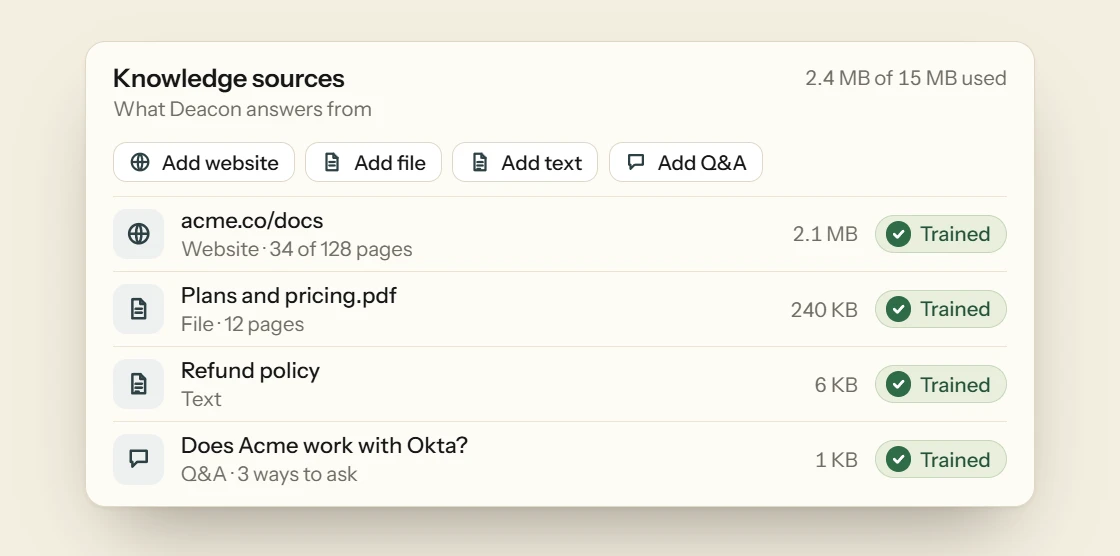
A knowledge base chatbot answers customers from your own documentation and nothing else. You may also see it called a custom knowledge base chatbot, a docs chatbot or an AI knowledge base, and the technique underneath is retrieval-augmented generation. Deacon reads the pages you pick from your website, the files you upload, text you paste and answers you write. For each question it finds the passages that bear on it and writes the reply from those. If your content has nothing on the question, Deacon tells the visitor so.
On every plan, including the free one.
At a glance
| What it reads | Pages you pick from your website, single links, uploaded files, pasted text and answers you write. |
|---|---|
| File types | PDF, Word (.docx), Markdown, plain text, CSV and HTML. A scanned PDF is read too. |
| How it answers | It finds the passages in your content that bear on the question and writes the reply from those alone. |
| The source | An answer from one of your web pages carries a link to that page. An answer from a file, pasted text or a written answer carries none. |
| When it doesn’t know | It tells the visitor so, and they can leave an email address for your team. It won’t give a price, a number, a date or a policy your content never states. |
| Keeping it current | You re-fetch a page by hand when it changes. Nothing is crawled again on a schedule. |
| Plans | All plans. A plan sets four things, how many answers Deacon gives a month, how much content it holds, the pages it crawls a month and the seats on your team. |
| What it isn’t | A wiki bot for your own staff, or a bot inside Slack or a helpdesk. It answers customers on your website. |
The path from your docs to an answer
What you do once, and what Deacon then does with every question.
Choose what it reads
Enter your site’s address and Deacon finds its pages, up to a hundred in one crawl. Nothing is learned until you tick it, so you pick the folders and pages that are fit to quote and leave out the blog post from three years ago. Sections that are translations of your main pages, such as /fr/, are skipped. Add anything that isn’t on the site as a file, as pasted text or as a question and answer you write, and it starts answering as soon as it has been read. Pages you tick from a crawl go in when you press Retrain agent, so nothing you are still choosing reaches a customer, and nothing changes under your feet while you work.
It finds the passages for each question
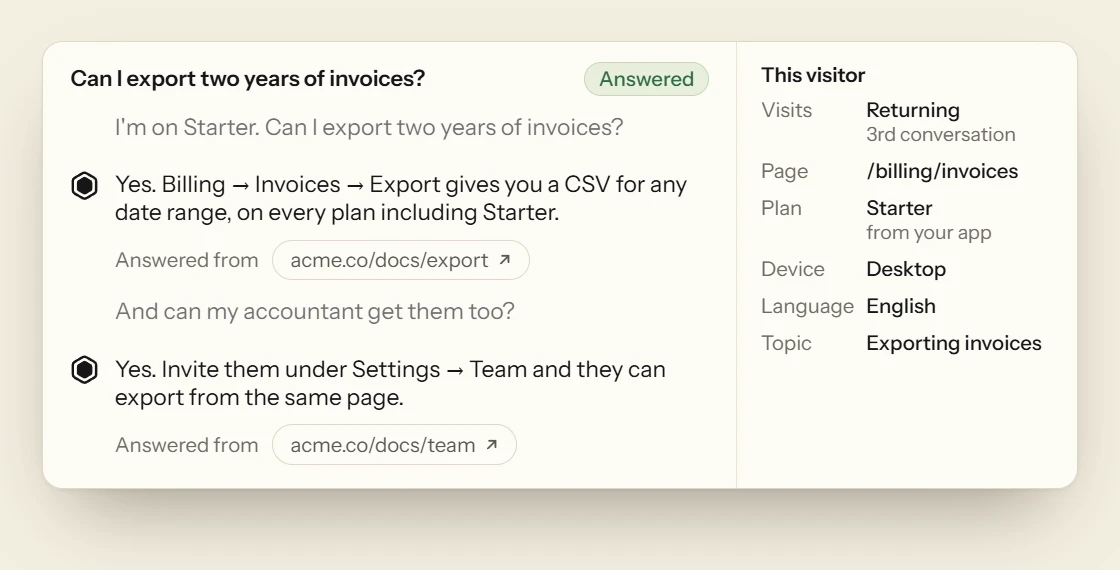
Deacon splits your content into passages and indexes each one by its meaning and by its words. When a visitor asks something, it pulls the few passages closest to the question, and a follow-up question gets a few more. An answer you wrote yourself is preferred over your other content when the two disagree, so a written answer is how you correct Deacon without editing your docs. If your app tells Deacon the visitor’s plan or role, that is taken into account too.
It writes the answer from those passages alone
Grounding is the word for this step. The model is told to use only the passages in front of it, to treat them as information and never as instructions, and never to join two separate facts into a claim no passage makes. The reply is written in the visitor’s language, whatever language your docs are in. When the answer came from a page on your site, a link to it sits under the reply, so the visitor can read the rest. If the question is too vague to answer, Deacon asks one question back before it tries.

With nothing to go on, it says so
Deacon won’t give a price, a number, a date or a policy detail that your content never states, even when your docs discuss the subject around it. It tells the visitor it doesn’t have the answer and offers a field for their email address. A question about the visitor’s own account or invoice is always declined, because Deacon can’t see their account. A question it couldn’t answer is tagged Unanswered in the dashboard, or Wants a person when the visitor asked for one. Each answer it did give names the source behind it, or reads “Your content” where it named none.
Point it at your docs on the free plan
Pick a few pages, ask what your customers ask, and read the answers before any visitor does. Chats in the Playground are never counted. You get 50 answers a month on the free plan, and it needs no card.
How to get a knowledge base ready for a chatbot
A bot can only repeat what you have written down. These help with any tool that answers from your content.
One subject to a page
A bot retrieves passages, a few paragraphs at a time. A page that covers one subject under a plain heading gives it clean passages. A long page that wanders gives it fragments.
Use the words your customers use
If customers say “invoice” and your docs say “billing statement”, the match is weaker. Put the customer’s word in the heading or the first sentence.
Write down what only you know
Much of what customers ask isn’t in the docs because nobody thought to write it. That includes limits, exceptions, what happens when a payment fails and whether a plan can be paused. Add them as short pages or as written answers.
Give numbers and names exactly
“Large files may be rejected” can’t answer “how big a file can I upload?”. State the limit, the plan it applies to and the menu path.
Remove what is out of date
A bot quotes an old page as readily as a new one. Delete or fix the pages you wouldn’t want read out to a customer, and after a release, check the pages it touched.
Say what you don’t do
Customers ask whether you support things you don’t. A short page that says so lets the bot give a straight no. Without it, a careful bot can only say it doesn’t know.
Questions about knowledge base chatbots
It can, if it is allowed to answer from what the model already knows. That is a hallucination. Deacon is told to use only your passages and to decline when they don’t state the fact asked for. Why support bots make things up
Deacon’s free plan reads your content and answers on your site for as long as you like, with no card. It is smaller than the paid plans in how much it can read and how many answers it gives a month. See the plans
Re-fetch the page that changed, or upload the file again, and press Retrain agent. Until you do, Deacon keeps answering from the version it has.
Each plan sets a size limit for everything Deacon has read, and a number of pages it can crawl a month. One crawl stops at a hundred pages whatever the plan, and a single file can be up to ten megabytes. The pricing page has the figures.
Not directly, because Deacon has no integrations with other tools. Publish the pages and crawl them, export them as PDF, Word or Markdown and upload them, or paste the text in. How to point an AI chatbot at your documentation
It isn’t built for that. Deacon answers on your public website, and has no Slack or Teams app.
Ask it something from your own docs
It takes about five minutes to install. The free plan is 50 answers a month, for as long as you like.