Human handoff
Human handoff is the point where a chatbot stops answering and a person takes over. It is also called escalation, live agent transfer or human takeover. Deacon hands over when your content doesn’t cover a question, or when the visitor asks for a person. It asks the visitor for an email address. When they leave one, or ask for a person, the owners on your team are emailed, unless one of you already has the dashboard open. You reply from the dashboard.
On every plan, including the free one.
At a glance
| When Deacon hands over | When nothing in your content covers the question, when it is about the visitor’s own account or invoice, when the visitor asks for a person, and after three clarifying questions that still haven’t led to an answer. It keeps answering other questions until one of you replies. |
|---|---|
| What the visitor sees | Deacon says it doesn’t have the answer and shows a field for their email address. |
| How you find out | The owners on your team get an email three minutes after the visitor leaves an address or asks for a person. If one of you has the dashboard open, it shows there and no email is sent. |
| Where you reply | In the conversation itself, from the dashboard. A visitor who still has the chat open sees your reply there. One who has gone gets it by email, if they left an address. |
| When Deacon answers again | In that conversation, when you press Hand back to Deacon. A conversation left quiet for twenty minutes closes, and the visitor’s next question starts a new one with Deacon. |
| Plans | Every plan, including the free one. |
| How often it happens | The share of conversations handed to a person is the escalation rate, which some tools call the human handoff rate. How to count the escalation rate |
| What it isn’t | A shared inbox. There is no routing, assignment or rota. |
How a handoff goes in Deacon
One handoff, from the question Deacon couldn’t answer to the moment it is answering again.
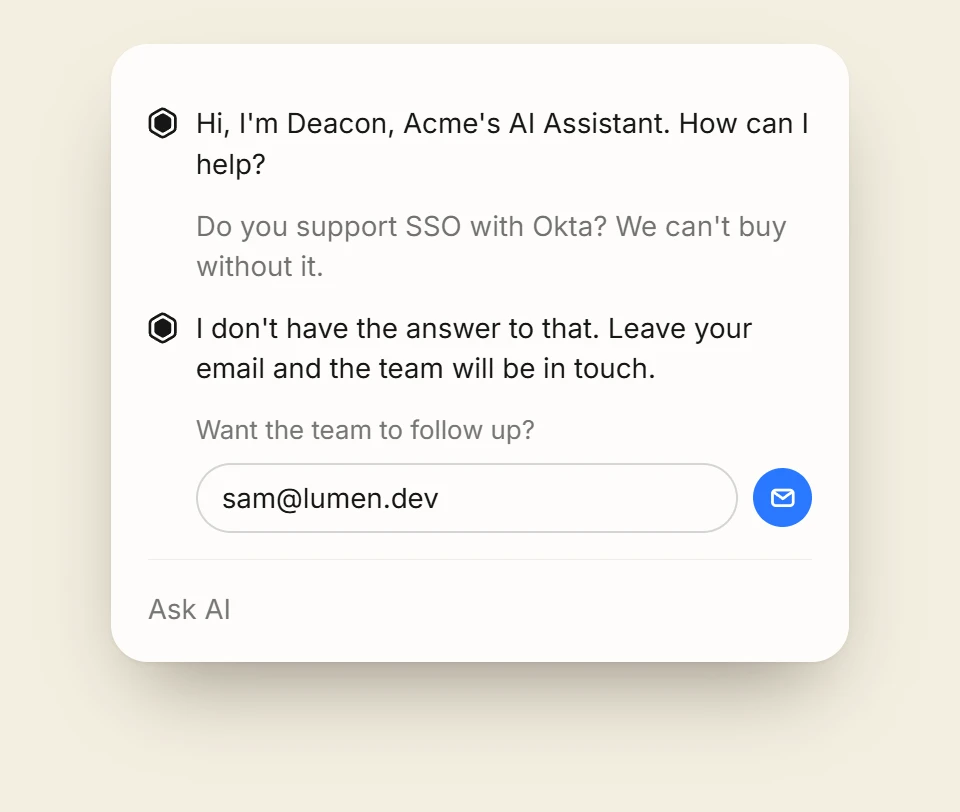
“Do you support SSO with Okta? We can’t buy without it.”
Tuesday, 09:14
Deacon says it can’t answer
Deacon writes its answers from your content. When nothing it found covers the question, it says so in the visitor’s own language and shows a field for their email address. Someone who writes that they want a person is offered the same field. If the visitor has already explained their problem, Deacon sums up what they told it in one sentence, so you don’t have to ask again. When the reply will plainly need one more detail, such as the exact error message, it asks for that once and passes it on.
Tuesday, 09:17
You get an email, unless you’re already there
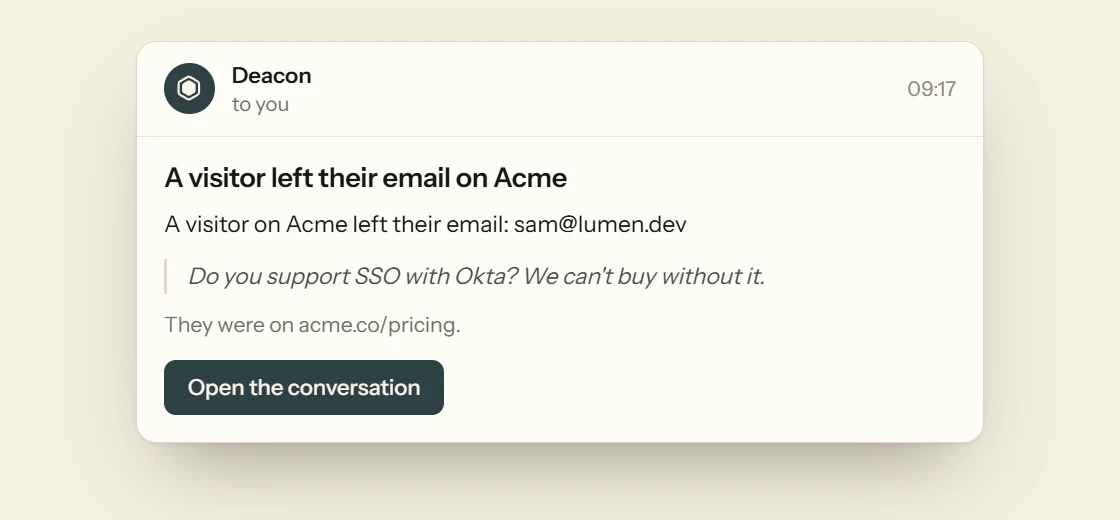
The owners on your team are emailed three minutes after a visitor leaves their address or asks for a person. The email quotes what the visitor last wrote and names the page they were on. The wait means that someone who adds two more lines causes one email and not three. If one of you has opened the conversation by then, or has the dashboard open, no email goes out.
Tuesday, 09:21
You reply from the dashboard
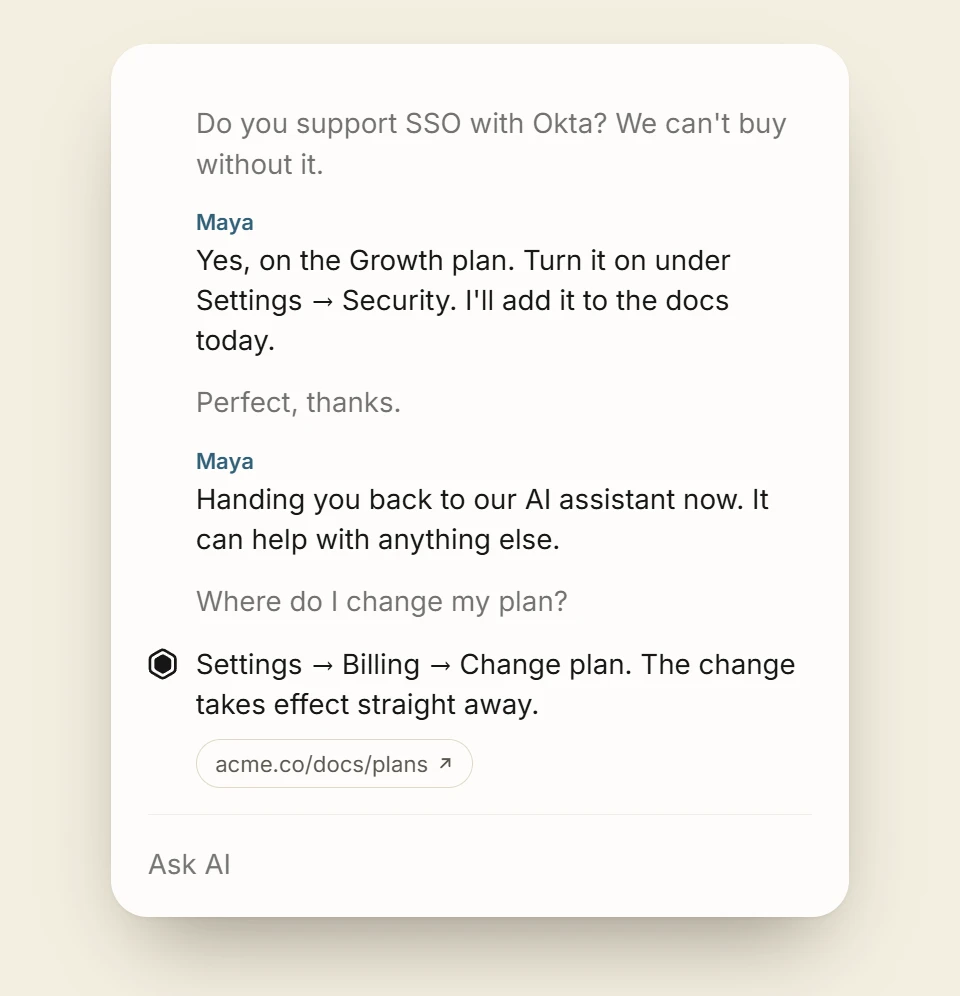
Open the conversation and type. Sending your reply takes the conversation over from Deacon. A visitor who still has the chat open sees your words there, under your first name and your company’s. A chat closes after twenty quiet minutes. After that, or once the visitor has left, your reply goes by email, if they gave an address in that conversation.

Tuesday, 09:26
You hand it back when you’re done
While you hold the conversation, the visitor’s messages go to the dashboard and Deacon stays quiet. You aren’t emailed about them, so keep the conversation open while you wait. None of them count towards your plan’s answers. Press Hand back to Deacon and a message in your name tells the visitor that the AI assistant is answering again. Until you do, Deacon stays out of that conversation. If it goes quiet for twenty minutes it closes, and a visitor who comes back starts a new chat with Deacon.
Handoff is on every plan, including the free one
Install Deacon, ask it something your docs don’t cover, and reply to yourself from the dashboard. You get 50 answers a month on the free plan, and it needs no card.
When a chatbot should hand over to a person
These hold for any support bot, whichever tool you use.
When it has no source
A bot that answers without a source is guessing in your company’s name. If it can’t point to where an answer came from, it should pass the question on.
When money or access is involved
Refunds, billing disputes, locked accounts and anything with legal weight should reach a person, even when your documentation covers them. The customer is asking for a decision.
When the customer asks for a person
Take their details the first time they ask. Don’t make them rephrase or ask again.
When they have rephrased twice
Someone who has asked the same thing three ways won’t get a better answer the fourth time. Hand over at that point.
Ask for one contact detail
An email address is enough to reply. Every extra field loses some of the people who would have filled it in.
Pass on what was already said
Whoever replies should be able to read the whole conversation first, so the customer isn’t asked to repeat anything.
Only promise a reply time you keep
“We reply within a working day” helps if it is true. If you can’t be sure, say the team will reply by email and leave the time out.
Questions about handoff
A teammate can reply inside any conversation, and a visitor with the chat open sees the reply there. There is no queue, routing or rota, so it suits a small team that replies when it can.
Your replies appear under your first name and your company’s, without the Deacon mark, and the box the visitor types in changes from Ask AI to Reply to the team. No separate notice says a person has joined. When you hand back, a message in your name says the AI assistant is answering again.
If they left an email address, your reply is sent there, and the first email carries the conversation so far. Without an address there is nowhere to send it, which is why Deacon asks for one before it hands over.
No. Only answers Deacon writes are counted. Messages between a visitor and a teammate still arrive when the plan’s answers have run out. Once they have, Deacon can’t judge who is asking for a person, so the owners are emailed only when a visitor leaves an address.
No. Deacon has no helpdesk or Slack integration. A handoff goes to the Deacon dashboard and to your email.
See a handoff on your own site
It takes about five minutes to install. The free plan is 50 answers a month, for as long as you like.