USE CASE
AI customer support for SaaS founders who answer it themselves
At a small SaaS company, support is the founder’s inbox. Deacon answers what your help pages cover and sends you the rest, with the page it was asked from.
Published
If you built the product, the support email probably comes to you, and every question in it arrives in the middle of other work.
Deacon puts an AI support agent in your app and on your marketing site. It replies to customers from what you have already written, whether that is help pages, files or answers you saved, links the page it used, and passes you whatever it cannot answer.
The questions that stop arriving
Most of a founder’s support mail asks something that has been answered before. Somebody wants to know how to invite a teammate, somebody else whether there is an API, and a third how to change the card on file.
Deacon answers those where they get asked, in the customer’s words and in whatever language they wrote in. When one of your pages supplied the answer, that page is linked underneath. Every conversation is kept in Conversations if you want to read it later.
It cannot act on anyone’s account. It cannot change a plan, reset a password or look at a customer’s screen, and it says so if somebody asks it to. Anything that needs your app to do something still comes to you.
What still reaches you
| When a customer | Deacon | What you get |
|---|---|---|
| Asks something your pages answer | Answers it and links the page | Nothing, unless you go looking |
| Asks what twenty others asked this month | Answers each of them | One topic on Analytics › Widget, with a count |
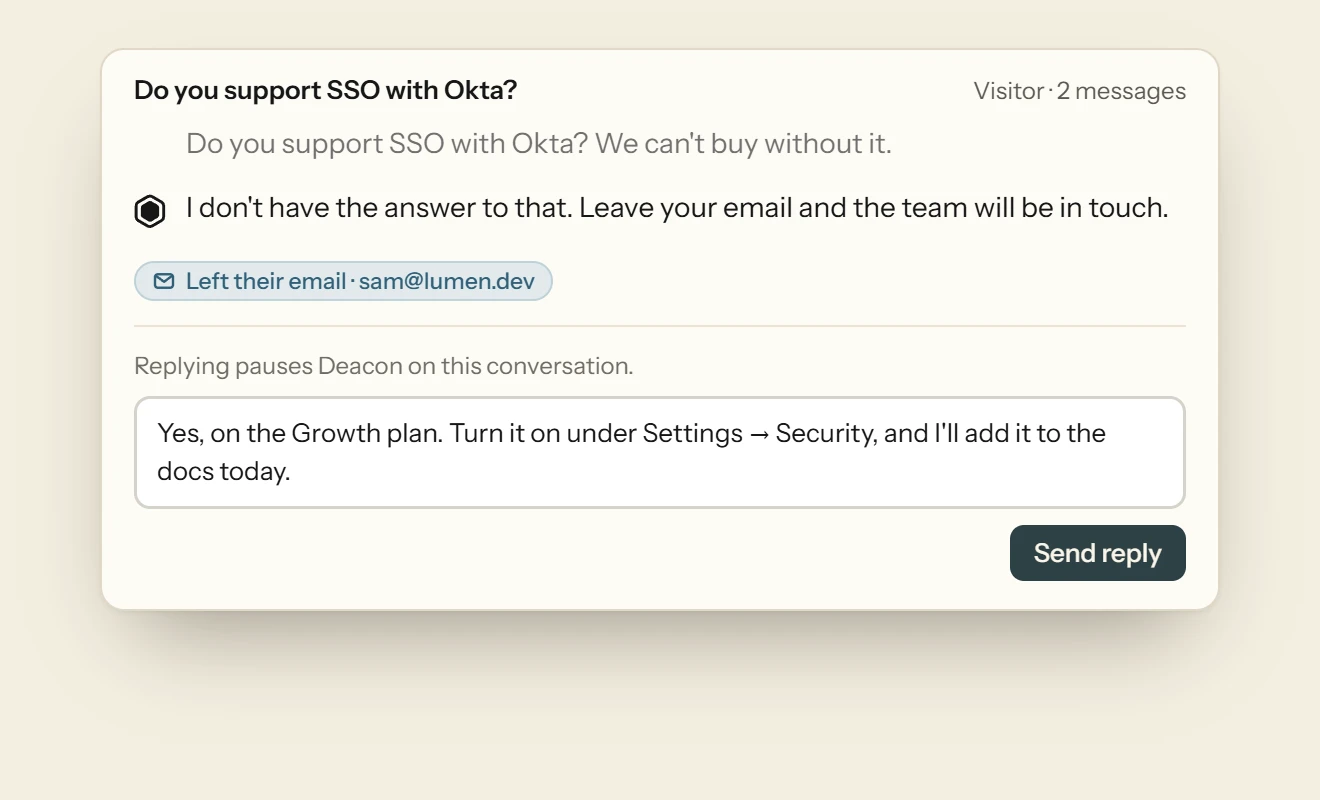
| Asks something no page of yours covers | Says it does not have the answer and asks for their email | Their question and the page they were on, once they leave an address |
| Asks for a person | Takes their email address | Word that a customer is asking for a person, with a way into the conversation |
Asks something your pages answer
- Deacon
- Answers it and links the page
- What you get
- Nothing, unless you go looking
Asks what twenty others asked this month
- Deacon
- Answers each of them
- What you get
- One topic on Analytics › Widget, with a count
Asks something no page of yours covers
- Deacon
- Says it does not have the answer and asks for their email
- What you get
- Their question and the page they were on, once they leave an address
Asks for a person
- Deacon
- Takes their email address
- What you get
- Word that a customer is asking for a person, with a way into the conversation
A request for a person raises a toast in the dashboard and a left address raises a badge, and if nobody has the dashboard open, both are emailed to the team’s owners with the customer’s words and the page they were on.
You reply from the conversation. Replying pauses Deacon on that conversation so it does not talk over you, and Hand back to Deacon lets it carry on afterwards. A customer still in the chat sees your reply there. One who left their email and closed the chat gets it by email, and the first email carries the whole exchange, so they have everything they asked in front of them.
Bug reports and feature asks
Deacon groups most questions by what they mean, and Analytics › Widget sorts those groups into lanes. Two of the lanes are bug reports, where people describe something broken, and feature asks, where people want the product to do something it does not. Each group is ranked by how many people are in it and links to the conversations behind it, so you can read what people wrote.
Inside your app
Inside your signed-in app, Deacon can know who it is talking to if your layout tells it. You hand it a small object with the customer’s plan, whether they are on a trial and what role they have, and it answers for that customer. The code is in the guide to adding a chatbot, and the install guide covers the dashboard side.
Add data-no-page-views to the tag on signed-in pages while you are in that layout. Page views are then counted on your public pages only, so your own clicking around the app is not mixed into the traffic. Any goal you fire from inside the app, such as an upgrade, is still recorded.
The free plan, and what uses it up
The free plan has one seat and 50 answers a month, and you do not need a card for it. Each reply Deacon writes to a customer counts as one answer, including a reply to a follow-up and a question Deacon asks back to work out what somebody meant. A reply saying it does not have the answer counts when Deacon read some of your pages before saying so, and is free when nothing in your knowledge base matched the question at all. Deacon emails you when most of the month’s answers are gone.
Nothing you ask it yourself in the Playground is counted, and neither is anything asked from localhost or another development address.
Try it on your own documentation
Add your help pages, ask it the question you know your docs cannot answer, and watch it say so.
The free plan covers 50 answers a month on one seat, and the paid plans are on the pricing page.
Free plan, no card.
READ NEXT
How to reduce support tickets, and the three you should never deflect
Most of your tickets are six questions wearing different clothes. How to find out which six, what to do about each, and where deflection turns into hiding.
A documentation AI assistant for more docs than anyone reads
An AI support agent that answers from your documentation, links the page it used, and shows you which questions and which pages leave readers stuck.
How to use Deacon
Install Deacon with one snippet, style the button and window, build its knowledge base, open it from your own button, and handle what it can’t answer.